
Okay, so somebody in the Broadway awards apparatus needs to sit down and have a real conversation with themselves, because what is coming to 47th Street this fall does not fit in the boxes they’ve been using, and I am not interested in watching brilliant work get filed under the wrong header for another year.
Here’s what I keep seeing: the industry creates categories for the shows it already knows how to make. Musical, play, revival, special theatrical event. And then something arrives that is, simultaneously, all of those things and none of them, and the committees squint and pick the container that loses the fewest points, and the choreographers and the lighting designers and the ensemble of forty who held that whole machine together get thanked in a speech if the show is lucky. This is not a new problem. It is a problem that is about to get very loud.
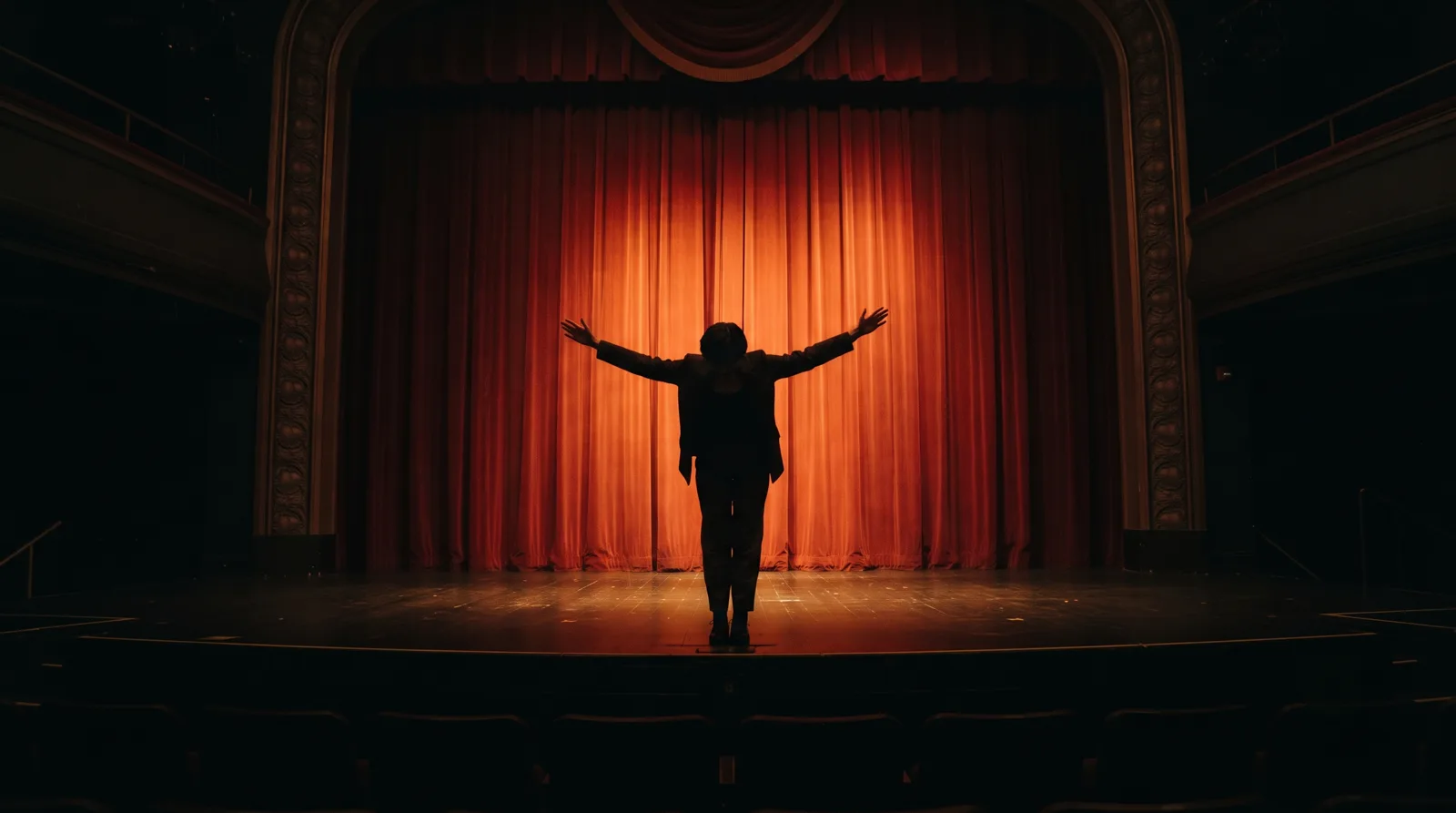
“Red Frequency,” opening at the Tillman Theatre on October 3rd, is the show I am most watching to see how the industry responds. Choreographer Adaeze Mori has built what I can only describe as a kinetic argument: the entire production is structured around the ensemble moving in and through the scenic elements, which are designed by Tomás Reyes to collapse and reassemble in real time using a hydraulic platform system that I watched in rehearsal with my mouth open. The lighting design, by Suki Aranda, works in concert with the platforms, so that as the stage configuration changes, the color temperature shifts from warm amber to a blue-white that makes the dancers look like they’re performing inside a pulse. It is not a lighting effect. It is a narrative device.
And then Zola Pemberton walks out for her act two entrance, and EVERYTHING stops being theoretical.
I have been watching Pemberton work for years, since she was in the ensemble of that scrappy downtown production of “Hollow Point” that nobody saw but everybody who saw it still talks about. She is an instrument. In “Red Frequency,” she carries the emotional through-line of a show that could easily lose the human story inside its own spectacle, and she does it by doing something technically precise and emotionally enormous: she stays small. While the ensemble around her executes forty-person formation work that builds in density across the second act, Pemberton holds still. She becomes the point of stillness that makes the motion legible. The choreography gives her stillness meaning, and she gives the choreography stakes.
The ensemble moment I have to put on record is the transition at the top of act two, where the company enters from four different vomitories simultaneously, moving in a canon that hits the downstage center mark in exactly twelve counts. Watch the spacing. Mori has calibrated it so that the bodies arrive at equal intervals and the effect is not “lots of people entering” but “a single organism arriving from all directions.” It is the kind of precision that looks effortless because it took six weeks of rehearsal to achieve.
Okay, here’s where I have to be real with you. The book, written by Celine Marchetti, is doing a lot of thematic heavy lifting in a show that is primarily communicating through movement and design, and the seams show in the first act. There is a twenty-minute stretch before the intermission where the dialogue is trying to explain what the staging is already making you feel, and those two things work against each other. A tighter dramaturgy in the first half would let the production fully deliver on what it promises.
But here is what I know. “Red Frequency” is going to arrive at awards season and the committees are going to have to decide what it is. A musical? A dance event? A theatrical spectacle with songs? The right answer is a MASTERWORK of collaborative design, and the fact that that answer doesn’t fit a pre-existing category is not the show’s problem. It is the industry’s problem. And the industry should fix it before the next Adaeze Mori builds something even harder to contain.
Get your tickets for “Red Frequency” before the industry figures out it’s a category unto itself, because once they do, everyone is going to want in.