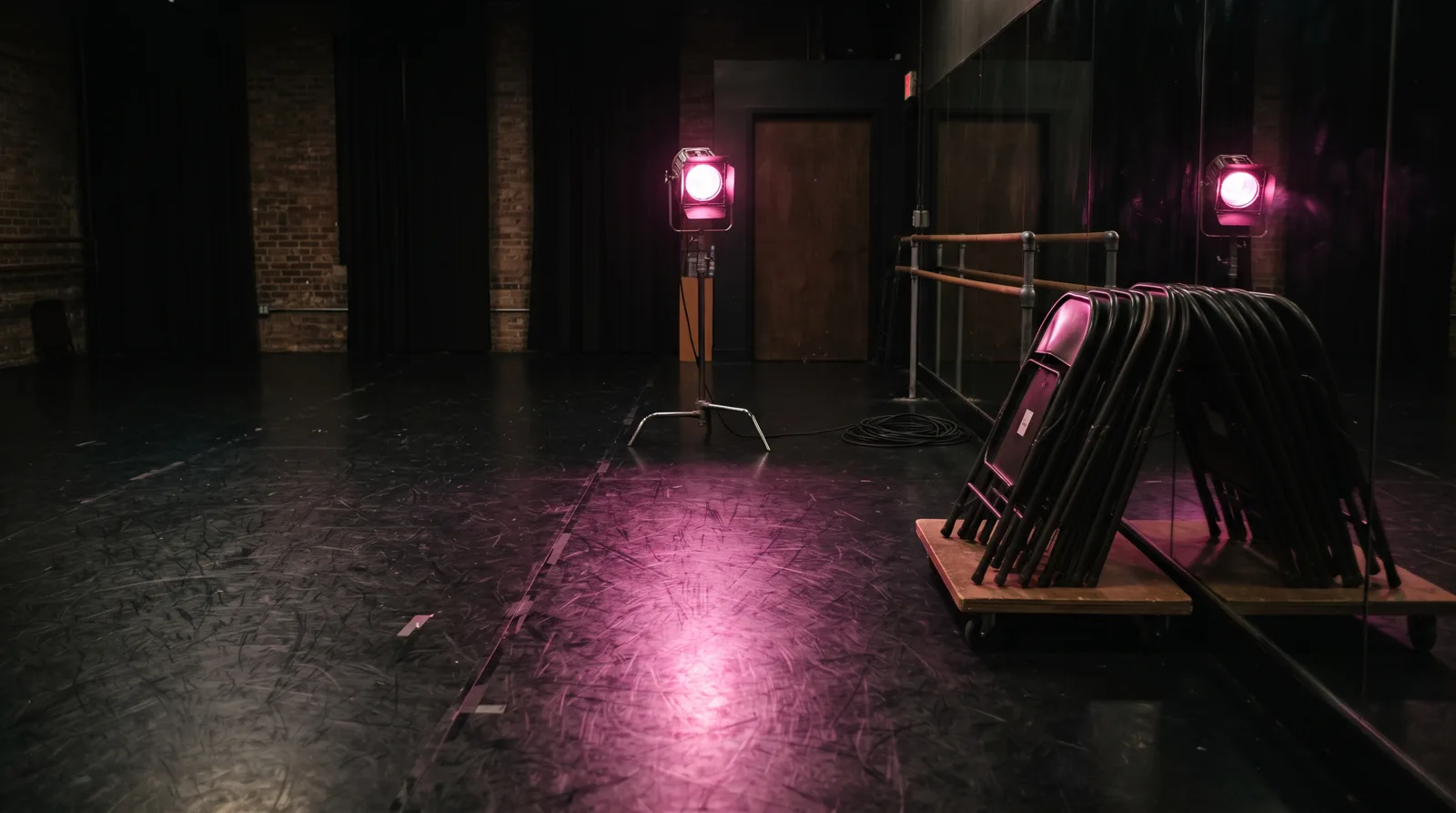

Celeste Amara-Kwei has been developing “Five Versions of the Exit Interview” for three years, which is about how long it takes a formally serious downtown play to find a theater willing to trust the form. The Palisade, the sixty-seat black box in Tribeca, has made the commitment. Previews begin October 14, with opening night set for October 27.
The play’s premise is structural: the same conversation, a job exit interview between a Ghanaian-American woman named Dora and a white HR manager named Paul, runs five times in sequence. Each iteration shifts tense, register, and grammar. The first is naturalistic. The second is interrogative, all questions, no answers. The third is conducted entirely in the passive voice. The fourth is Dora’s interior monologue replacing the dialogue she actually says out loud. The fifth is silence with subtitles.
This is the kind of structural commitment that either reveals something irreducible about power and language, or collapses under its own conceit. Amara-Kwei has earned the right to attempt it. Her 2024 short play “Adjustment Period,” staged at the Foundry’s new voices program, did something similar on a smaller scale: a single scene between a woman and her landlord repeated three times with progressive linguistic deterioration. That piece ran 25 minutes. It worked completely.
“Five Versions” is asking the form to sustain ninety minutes, which is a different proposition. The question the Palisade production will have to answer is whether Amara-Kwei has built enough variation into each iteration to keep the audience inside the structure rather than watching it from the outside. Caryl Churchill solved this problem in “Top Girls” by breaking chronology so violently that you couldn’t fall back on narrative expectation. Amara-Kwei is working inside chronology, which means she has to earn the repetition through language alone.
Directing is Simone Batiste-Osei, whose work on last season’s “Corridor Studies” at the Marrow Room showed a real command of spatial dramaturgy. That production used the architecture of a hallway to make visible the hierarchy of who moves through institutional space and who waits in it. The same preoccupation is clearly in play here. Batiste-Osei staging an office exit interview will have access to every visual grammar of corporate power: the desk angle, the closed door, the position of the water glass. Whether she uses that vocabulary to reinforce Amara-Kwei’s linguistic architecture or simply decorates it will determine how much this production lands.
The cast has not been announced in full. What the Palisade has confirmed is that Adaeze Nwosu plays Dora across all five versions. Nwosu’s work has been largely in ensemble pieces, and this will be her first major single-character showcase. Playing the same woman five times in a row, each time with a different relationship to her own words, is a technical and emotional problem with no easy solution. She either builds a through-line that the form keeps dismantling, or she plays five distinct psychological states and risks fragmenting what Amara-Kwei clearly intends as one continuous self. That is the central performance question.
The tradition Amara-Kwei is working in is traceable: the British structuralists, Churchill foremost, and the American descendants of that line, particularly Young Jean Lee, whose work demonstrated that formal radicalism and emotional directness are not mutually exclusive. What “Five Versions” has going for it, based on the developmental readings I have seen, is that the emotional stakes of Dora’s situation are never in competition with the formal game. They are the same thing. The form is the argument about power. That is harder to achieve than it sounds, and the fact that Amara-Kwei appears to have achieved it in workshop is the reason this production matters.
If she has solved the ninety-minute problem, this will be the most structurally serious new play downtown this fall, and you should be in that room.
“Five Versions of the Exit Interview” runs October 14 through November 22 at the Palisade. Tickets are available through the Palisade box office.