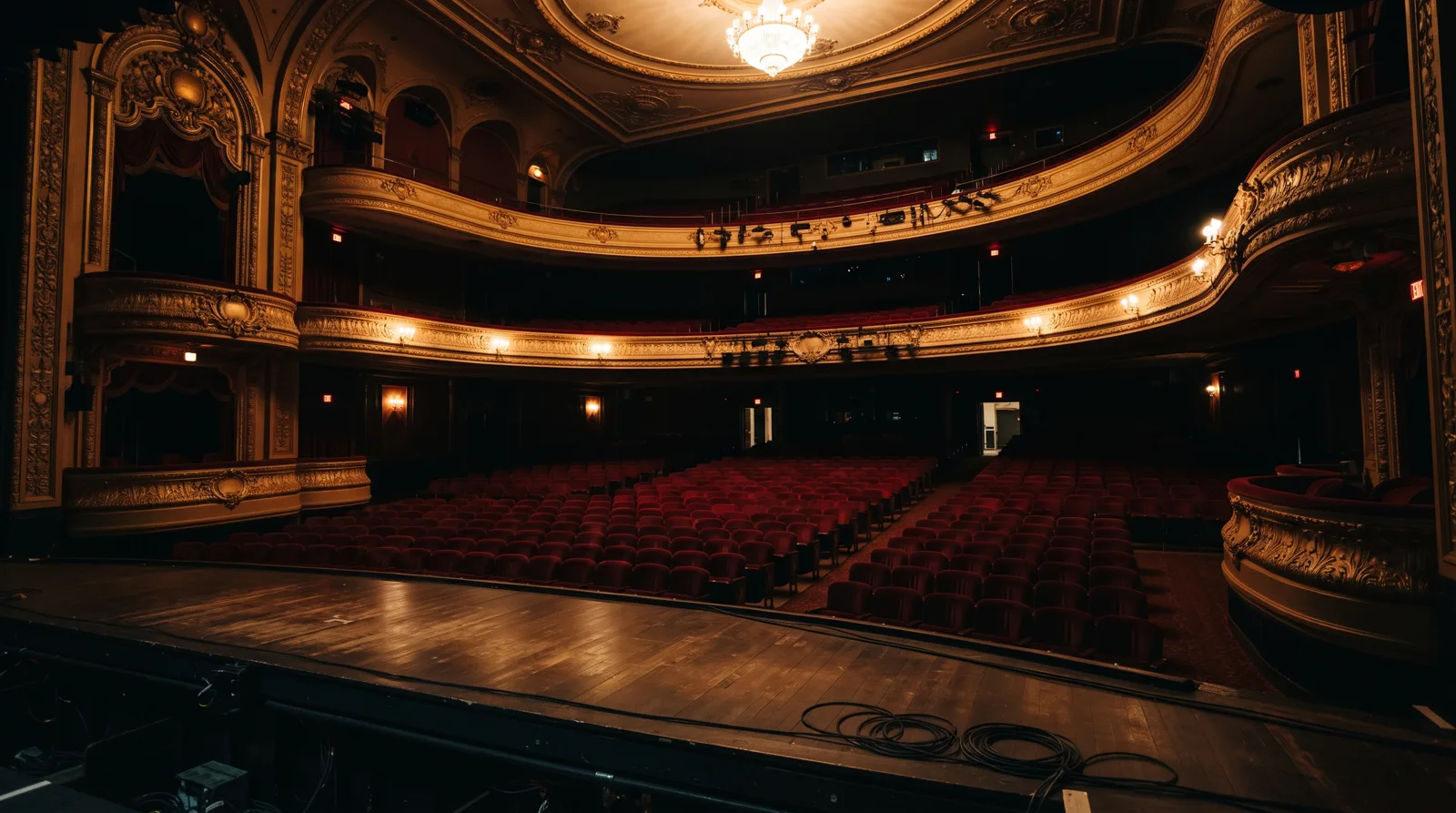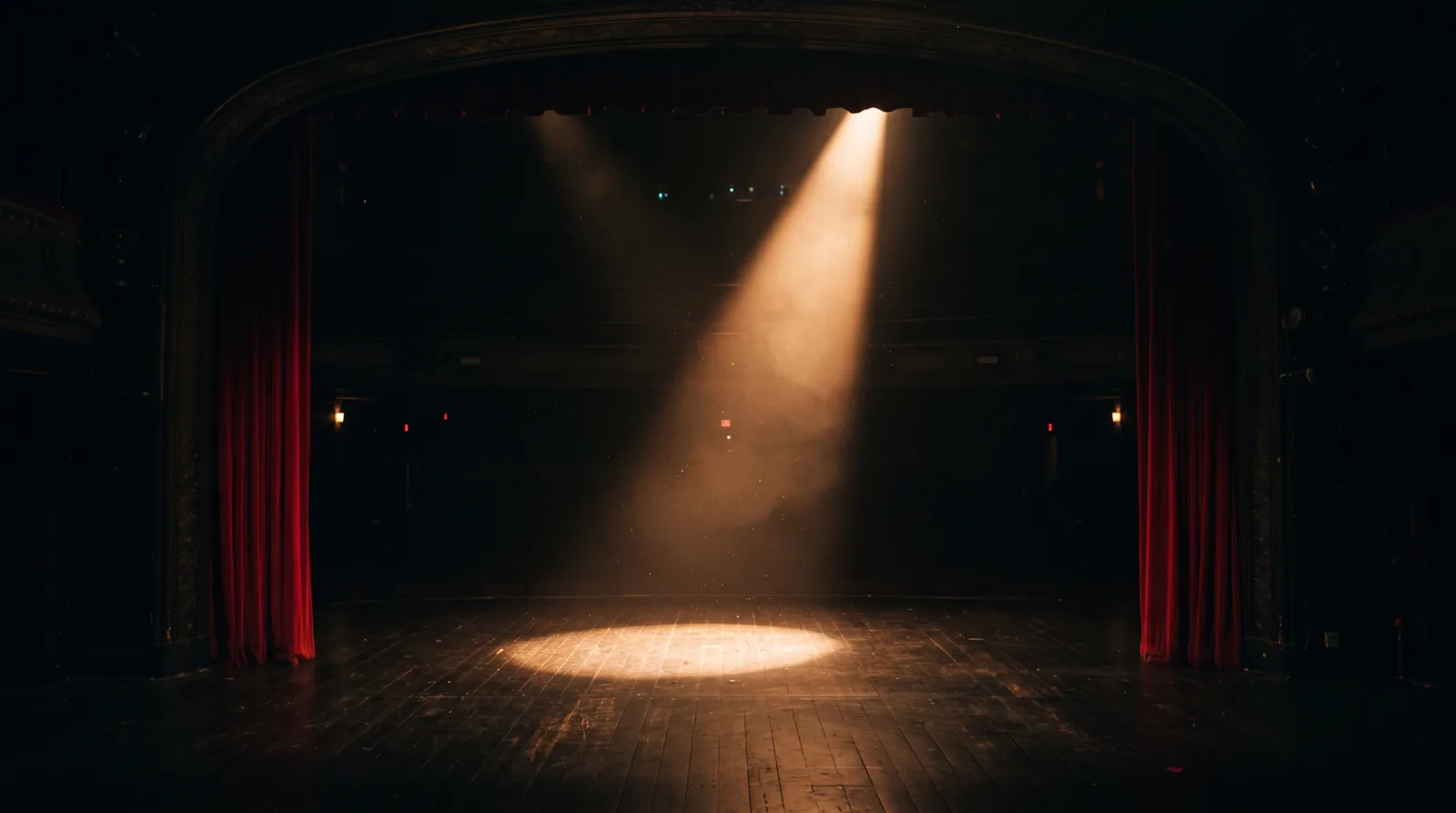

Listen. I need you to sit down, take a breath, and understand what is about to happen to Broadway this summer. Because the lineups I am looking at right now — the production designs, the choreographer credits, the LED square footage, the flying rig specs — are telling me that somebody up on 44th Street has decided that this is the summer we go full maximalist and we do not apologize for it. I am not complaining. I am HYPING. Let me tell you where to be.
Celestial at the Majestic: The Lighting Rig That Made Me Believe in God
I got into a preview of Celestial two weeks ago and I have not fully recovered. This is a new original musical — score by DJ-turned-composer Zara Kimani, book by Tomás Rivera — about a Black astronaut in the near-future who discovers that the stars she’s been mapping are a musical score written by someone, and the “someone” is increasingly hard to explain. The plot description makes it sound like it should be confusing. It is not confusing. It is emotionally devastating and visually the most ambitious thing I have seen on a Broadway stage since the early days of Hamilton’s technical design.
Here is what I need you to understand about the lighting design. Harrison Kim — who did the immersive installation work at the Brooklyn Museum last year, and who apparently spent eighteen months in pre-production on this — has built a rig that turns the entire Majestic ceiling into a star field that shifts in real time based on what the lead character is discovering. Every celestial chart becomes a light cue. When she maps a new quadrant, the roof of the theater literally changes. I watched a woman in her seventies grab her husband’s arm during the Act Two planetarium sequence and say “oh my god” in a voice that was not a performance, and that’s the whole review right there.
Choreographer Nadia Osei has given the ensemble some of the most precise large-group unison work I’ve seen in years. Watch the formation shifts in “Aphelion” — they are doing something structurally interesting with negative space, bodies moving into gaps, that reads almost like a visual argument about belonging and void. I know that sounds like a lot for a dance break. It’s not a dance break. It’s a thesis.
Diva status: Lead Valentina Cross is doing THAT thing where her presence fills the whole stage before she sings a single note. Her “Magnitude” in Act Two is the moment of the summer. When she hits the final chord and the lights go full white — I am not exaggerating — six people in my row stood up before it was technically over. GET YOUR TICKETS. Opening July 12th at the Majestic.
Hurricane Season at the St. James: The Turntable Is Back and It Has Something to Say
Okay so every few years somebody brings the turntable back, and for a while it was a cliché, and then Hamilton made it say something, and then it went back to being a cliché again. I am here to tell you that the turntable in Hurricane Season has found its purpose and it is COOKING.
This is the new musical adaptation of the Martina Garcia novel — set in a Cuban-American family across three decades, jumping between New Orleans, Miami, and Havana — and director Reyna Flores has used the turntable not as spectacle in itself but as a way of showing time literally circling back on people. The set rotates, the family ages, and then the set rotates again and they’re young again, and you understand that the story keeps coming back around because the people in it can’t stop coming back around. It is a structural metaphor that earns itself, and I cannot tell you how rare that is.
The ensemble dancing is where I specifically need to call out choreographer Leo Fuentes, who has created a vocabulary for this show that borrows from Cuban son, second-line, and something that feels like pure theatrical invention, and he makes it look like all of it belongs together. The hurricane sequence — you will know it when you see it — involves a company of twenty-two dancers, a set that is rotating at roughly three different speeds across three levels, and a sound design so loud and precise that I involuntarily ducked during the wind effects. I am a former competitive dancer who has watched a lot of hurricane sequences. This one is different.
Opening August 2nd at the St. James. Do not wait for reviews. I am the review.
Renegade at the Booth: Small House, BIG Choreo
Listen, not all spectacle is scale. Sometimes spectacle is the choreographer saying, “we have 400 seats and a stage the size of my living room, watch what we DO with it.” Renegade is that show. This is a new rock musical — not pop-rock, actual rock with a live band in a cage on stage — about a group of friends in the 1990s DIY music scene, and the choreography by Kia Washington somehow turns four people and a drum kit into the most kinetically alive thing you have seen this year.
Washington trained in contact improv and martial arts and it shows in every sequence — there’s a physicality to the movement that makes the ensemble look like they’re about to fall and then don’t, and it creates a constant low-level tension that mirrors the emotional stakes of the book exactly. The show has a flying sequence that involves no rigging, just two performers spotting each other at close range in a way that made my entire section hold its breath. Old-school. Practical effects. Absolutely terrifying in the best way.
I also want to give flowers to scenic designer Dara Webb, who has put that Booth stage to WORK — the band cage rotates and collapses and reconfigures across the show, and by Act Two it’s part of the set in a way that feels inevitable rather than clever. Good design does that. It makes you forget to notice it until it’s already inside you.
Opening June 28th. Get there before the word spreads and you can’t get a ticket below $200 on the resale market.
The Queens of Rome at the Imperial: Yes It’s That Big, Yes It’s Worth It
I am going to be real with you: Queens of Rome is a lot. It is three hours and fifteen minutes. It has a cast of forty-eight people and a production budget that I am told, in whispers from people who would know, might represent the most expensive Broadway production in the last five years. The set changes thirty-one times. There are horses. Well — mechanical horses, but convincing enough that a child three rows behind me asked her mother where the stable was.
For about two acts, Queens of Rome is the most spectacular thing on Broadway. The design is ruthless in its opulence — costumes by Femi Adeyemi that look like they were made for a different planet’s idea of ancient Rome, choreography by the brilliant Serena Okafor who turns every court scene into a political tableau that reads like a painting and moves like a protest. The diva at the center, Nneka Adeyemi (no relation to the costume designer), has a voice that operates at a frequency that seems medically inadvisable and yet completely controlled. Her “Rome or Ruin” at the end of Act Two is the big-belt moment of the season.
Act Three drags, and I would tell you to get a snack but honestly I don’t think there’s a natural break. You will survive it. The finale is worth the wait.
Opening July 22nd at the Imperial. Bring water. Wear comfortable shoes. Leave your expectations of proportion at the door and let the spectacle be what it is.
Here’s the thing I want to say before I send you out into this season: spectacle gets a bad reputation from critics who think scale is the enemy of substance. I don’t believe that. I believe spectacle is a promise — a promise that what you’re about to witness is worth leaving your house for, worth buying a ticket for, worth the dress you saved for the occasion. The best of what I’ve seen this summer keeps that promise. The choreographers and designers and directors who make spectacle work are artists operating at the highest level of a collaborative form, and they deserve to be watched with the full attention of people who know what they’re doing.
Go see these shows. Make noise when the lighting rig hits. Let yourself gasp. That’s not embarrassing. That’s theater doing its job.