

Carmen:
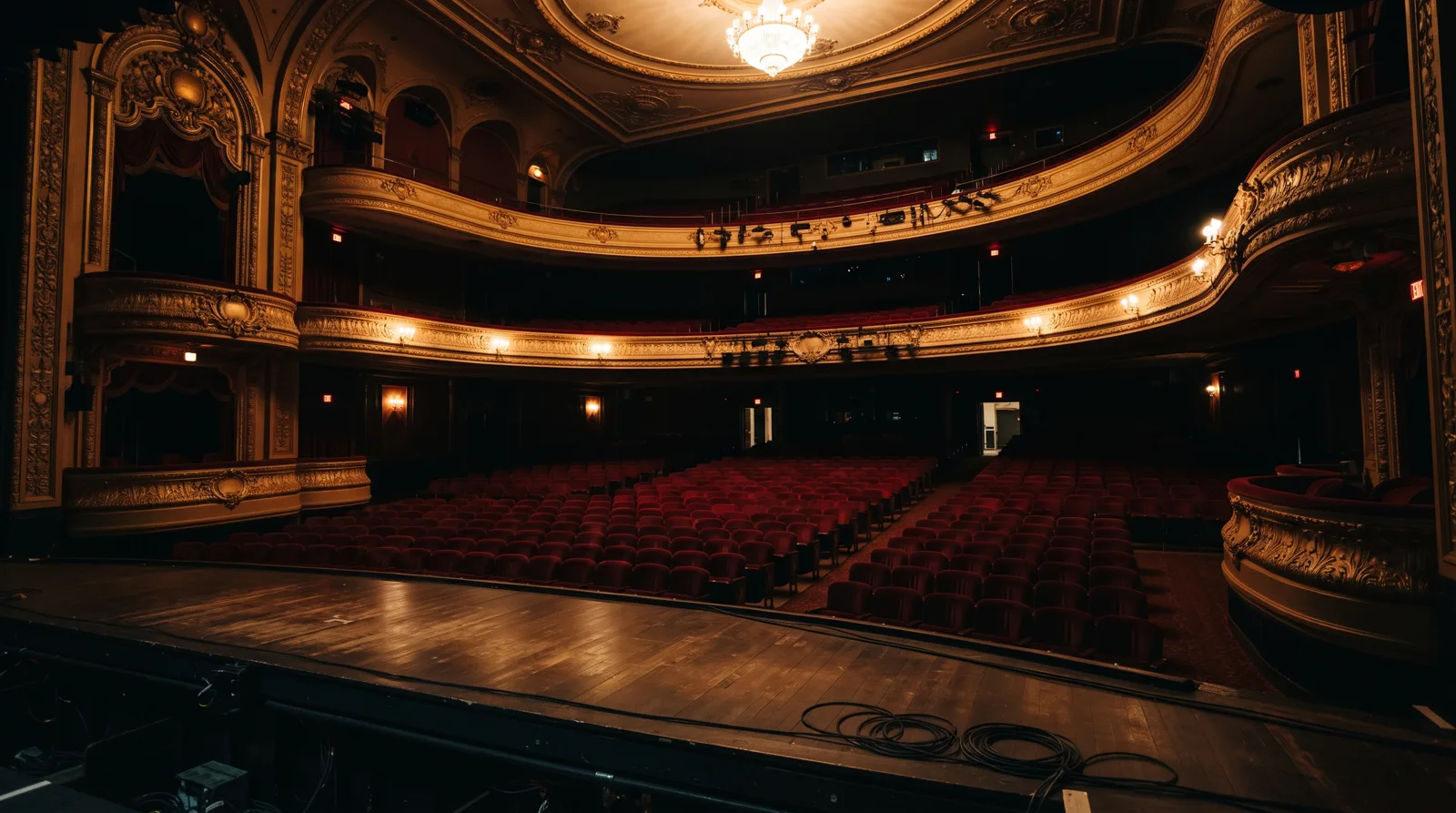
Marquee opens with a woman standing alone at the edge of a stage that is, for one full moment, completely dark. Then the lights find her. Not gradually — they slam on, full white, and she is simply there, surrounded by nothing, beginning to sing. By the end of the first sixteen bars, half the audience has forgotten to breathe. I watched it happen. I was one of them.
That’s the problem.
Director Solange Ferreira knows exactly how to do that to you. She knows the precise interval between darkness and light that makes a human body register as something holy. She has built Marquee — now filling the Dauphin Theatre on West 45th — into the most technically assured piece of work I have seen on Broadway this season. The score, by composer-lyricist team Darin Westfall and Keoni Akamai, moves with the confidence of people who understand what counterpoint is supposed to feel like in the body, not just on the page. The lead performance from Valentina Cruz — and I will have more to say about her — could anchor a lesser show and make it soar.
And yet. Mija, I sat there for two hours and forty minutes, and somewhere around the Act Two dream sequence — which is, by the way, visually the most beautiful thing anyone has staged at the Dauphin since the Pellegrino revival six years ago — I realized I could not tell you what Marquee was actually about. Not thematically. Not at the level that matters when the lights go back up and you’re standing on the sidewalk trying to figure out what you just witnessed.
It knows how to say everything. I am not sure it has anything to say.
Priya:
Carmen is describing a symptom. Let me name the disease.
What Marquee is doing — or failing to do — is a specific structural problem: the show has mistaken sensation for syntax. Westfall and Akamai have written a score that generates genuine emotional pressure, and Ferreira has staged it with the precision of someone who understands that every design choice is an argument. The problem is the book. Theodora Raines’s book for Marquee has no internal logic of accumulation. Things happen in it. They happen beautifully, in the correct order, with the correct emotional temperature. But they do not compound each other in any way that produces meaning. The dream sequence Carmen mentions — and yes, it is visually extraordinary — functions as pure interruption. It stops the argument of the show because there is no argument to stop.
This is what Sondheim meant when he talked about “integrated” not as a style but as a standard: the score should only be able to exist in this story, and this story should only be able to exist in this form. What Raines has written is a story in which any score would work. That is not a compliment. It means the structure is decorative. It means the spectacle is load-bearing precisely where the writing should be.
Valentina Cruz is doing something genuinely interesting with the lead — I will say that much. She is finding subtext in lines that were not written to contain any. That kind of performance is not evidence that the show is working. It is evidence that one actor is working considerably harder than the material deserves.
Imani:
Okay, here is what both of them are missing.
Carmen felt it. Priya diagnosed it. Neither of them was watching choreographer Desta Okafor reload forty-two dancers for that Act Two opener like a woman who was told she could do anything and decided to believe it. Because THAT choreography — the formation work, the way the ensemble splits into three independent rivers of movement and then collapses back into unison on a single downbeat — that is a structural argument. Okafor is doing the work the book refuses to do. She is accumulating. She is compounding. Every formation in Act Two is a consequence of the formation before it, and if you know where to watch, you can see the show Marquee wanted to be, embedded in the bodies of forty-two people who are giving it everything they have every single night at the Dauphin.
That is both the beauty of this production and the thing that breaks my heart about it.
Valentina Cruz, in the Act One finale — the twelve o’clock money moment, where the lighting rig drops to a single spot and she holds a note for what felt like geological time — that is a REAL thing. That is an artist keeping a promise spectacle made and the book could not. I watched the audience around me and they were gone. They were exactly where great theater puts you.
The show doesn’t earn that moment. She earns it anyway.
Go see Marquee. Go knowing what you’re walking into: a production that is technically extraordinary and structurally thin, with a dance company and a lead performance that are doing something worth witnessing. Watch the ensemble. Watch Okafor’s formations. Watch Cruz in Act One. You will see, in the bodies of this company, a better show than the one on the page — and that is still enough reason to be in that room.