

Carmen:
Two people. That’s what “The Last Ferry” gives you. Two people, a set that looks like a harbor at the end of the world, and a score that thinks it can carry the weight of everything unsaid between strangers who might have once been in love — or almost, or something worse.
It earns it.
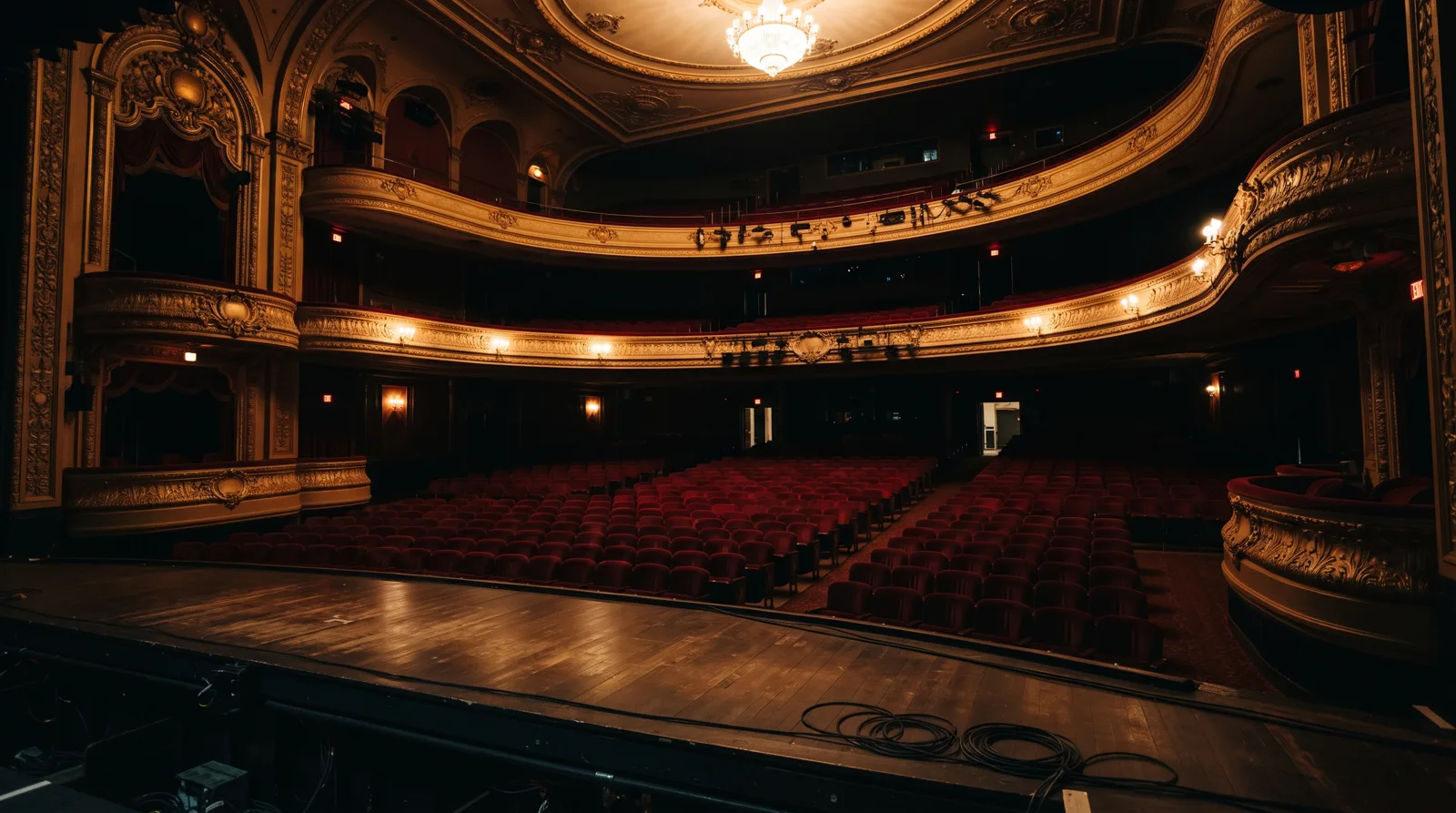
I walked into the Meridian Theater skeptical, and I will tell you that upfront because I have been burned before by the intimate-musical formula. The stripped-down aesthetic is sometimes a genuine artistic choice and sometimes just a budget decision dressed up in minimalism. What I found instead was something I was not prepared for: Delia Vásquez and Marcus Holt delivering ninety minutes of work so precisely calibrated that I forgot, genuinely forgot, that there were only two of them up there.
Vásquez, playing the woman who has missed this ferry three times before, has a quality I don’t often see on a Broadway stage — she listens. She doesn’t wait for her cue; she hears Holt and responds to what he actually gives her. When he delivers the second-act confession about the letters he never sent, her face does something complicated and quiet, and the audience — all of them — stopped breathing. I watched it happen. That silence is what you buy the ticket for.
Composer Renata Osei has written a score that knows exactly when to fill the room and when to leave it empty. Three musicians tucked into the wings, and not once did I miss an orchestra. The voices do the rest.
I’ll stake a claim before Priya and Imani weigh in: this is the most fully realized two-person musical I have seen in years. The small cast isn’t a limitation. It’s the whole argument.
Priya:
Carmen is right about the performances, and I’m going to set that aside because what interests me more is the structural decision the playwright — Soo-Jin Kwak — has made at the level of the book.
A two-person musical is not, at heart, an economic choice or even an aesthetic one. It is a formal argument about what dramatic space actually is. When you strip the chorus, you strip the social world. You remove the infrastructure through which a character’s interiority usually gets externalized — the ensemble that holds the weight of what the protagonist cannot say directly, the ensemble number that contextualizes a solo by surrounding it. Take all of that away and you have something closer to Beckett than to Sondheim: two voices in a void, making meaning through what they say to each other rather than through what exists around them.
What I find structurally interesting about “The Last Ferry” is that Kwak knows this. The book isn’t trying to fake a larger world. It’s not gesturing toward offstage relationships or doing expository work to compensate for the missing ensemble. The two voices are the whole world, and the harbor set isn’t background — it’s a formal statement about isolation as the condition of the play’s argument.
Where I want to push: there are two moments in the second act where the book reaches for conventional musical-theater emotional grammar — the obligatory statement duet, the near-miss reconciliation — and you feel the form straining against itself. Kwak has built something formally rigorous, then worried it might lose the audience and applied safety netting. The play is better without the safety netting. It’s good enough to know that.
Imani:
Carmen and Priya have handled the emotions and the thesis, so let me tell you what was happening in that room from my seat.
I cover spectacle. I track forty-body formation shifts and the moment a lighting rig hits a company mid-step and the whole house gasps at the same second. “The Last Ferry” gave me none of that — deliberately, structurally, as argument, as Priya says. So what do you do when the spectacle is the absence of spectacle?
You watch what two bodies can do when there is nowhere to hide.
Director Lena Moss — and I have been watching her work since her residency at the Foundry two seasons back — has choreographed this show in a way that has nothing to do with dance steps and everything to do with spatial physics. Every cross, every pivot toward and away, every moment where Vásquez and Holt occupy opposite ends of that harbor set: these are not blocking decisions. They are choreographic ones. The distance between two bodies is a formal element here, and Moss is using it the way a choreographer uses negative space. That takes training or genius, probably both.
The lighting design by Cleo Ferris deserves its own conversation. Three distinct looks in the full ninety minutes — I counted — and each one is doing the structural work of an entire scene transition. That restraint is HARD. Most designers cannot stop themselves from adding the fourth look, the fifth. Ferris stopped at three and the room was better for every choice she didn’t make.
My honest note, which echoes Priya’s: the show gets nervous in the second act and I felt it. The material is strong enough to let the silence sit longer than it does.
But then Vásquez landed that last note in the duet — a choice so specific and so quiet it could only come from someone who understood exactly what the room needed in that exact second — and I forgave everything.
Go see this show. Take someone you have unfinished business with. Sit close.