Fever of Glass has one of the best second acts I’ve seen on a Broadway stage in three years. The rest is a work in progress. Four stars — which I say knowing full well that’s generous, and meaning it anyway.
The new musical at the Caldwell Theatre tells the story of Lucinda Reyes, a Havana dance hall queen who arrives in 1920s Manhattan with nothing but her body’s memory of rhythm and a suitcase full of bad decisions. It’s a star vehicle built for Marisol Fuentes, and Marisol Fuentes destroys it — in the best possible way. She is the reason you are going to buy a ticket. She is the reason you are going to talk about this show in ten years.
There is a moment in the second act when Lucinda receives a telegram that changes everything — a piece of news so devastating that most productions would milk the silence, hold for applause, let the actress work. Fuentes doesn’t wait. She reads the telegram, folds it once, sets it on the table, and laughs. Not a breakdown laugh. Not a grief-cover laugh. A short, real laugh that says I knew it would come to this. That choice — spontaneous-seeming, clearly calculated, executed without a trace of the calculation — is the kind of acting that makes audiences go very still. The woman to my left stopped mid-unwrap of a cough drop and held it for the rest of the scene.
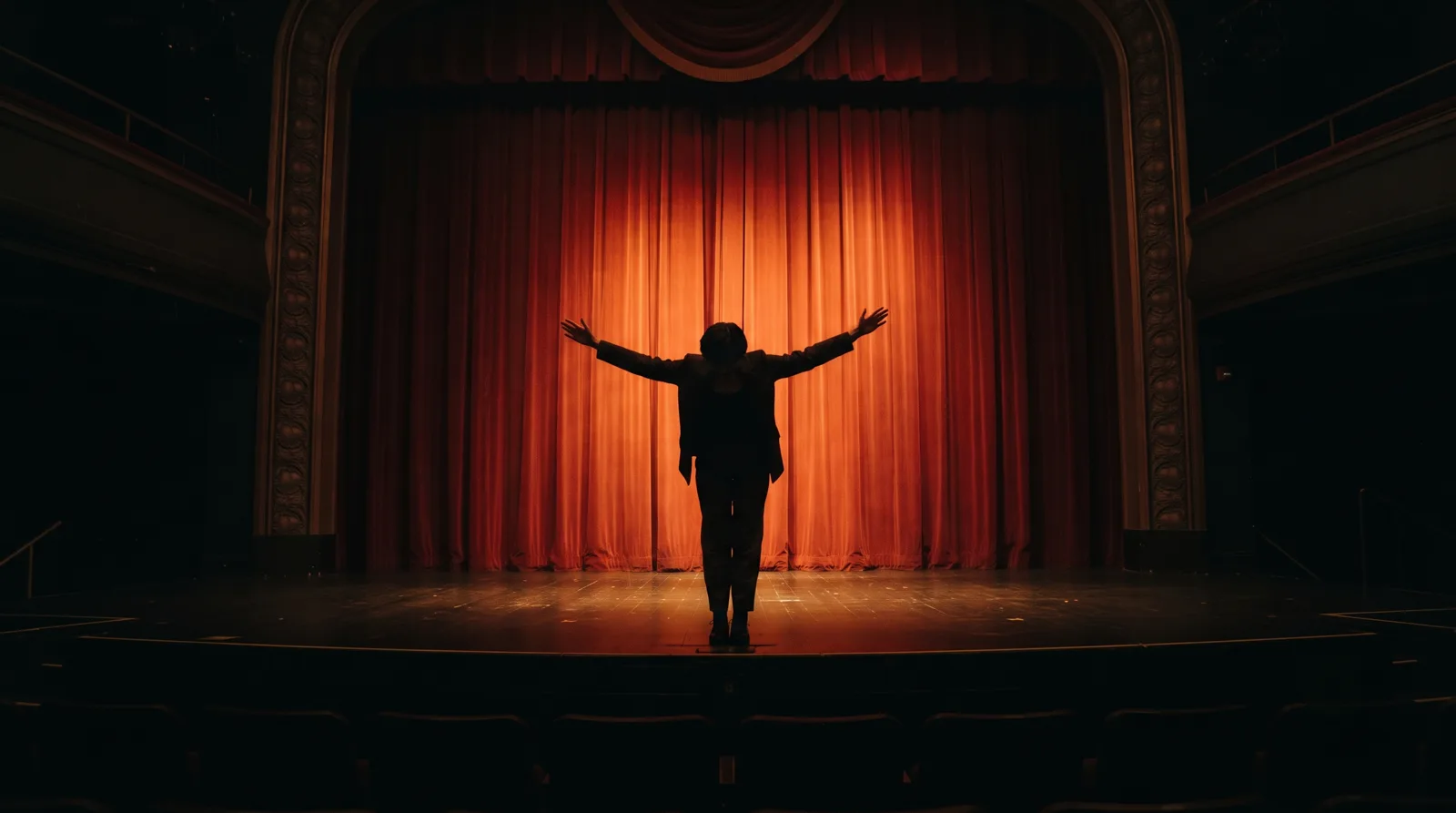
The production around her is beautiful. Set designer Rafael Ospina has built something that starts as a dance hall of amber wood and smoky lanterns and slowly, through a series of scene transitions that feel like film dissolves — one scrim dropping as another rises — becomes a Manhattan tenement, then a ballroom, then something harder to name. The final image of Act One, with Lucinda silhouetted against a grid of lit windows while the ensemble moves in a loose spiral around her, lands like a postcard you want to send to someone. The orchestra, conducted by Petra Halstead — who also co-wrote the score with her brother Jonah — has a sound that sits between a Latin jazz ensemble and a full Broadway pit. It should feel like a contradiction and somehow doesn’t.
So why the hesitation? Because the first act, mija, is a mess.
Director Terrence Okafor has clearly thought hard about the second act and let the first act sort itself out. The opening thirty minutes deliver exposition as if we already know these people — quick scenes that establish relationships without earning them, a few ballad moments that feel inserted rather than necessary, and a comic subplot involving Lucinda’s landlord that stops the show cold every time it appears. Not “stops the show” in the good way.
The score has high points and soft spots in roughly equal measure. “Burning in the Glass” — the Act Two centerpiece Fuentes turns into something close to holy — is a genuinely great musical theater song, the kind with a real harmonic argument inside it, where the key changes feel like decisions and not just movement. But two or three of the Act One numbers feel like placeholders, functional verses waiting for a third draft that never came.
Pero — and this is where I land — none of that changes what Marisol Fuentes does in this show. She has been working regional theater and touring companies for eleven years, and everything she learned in those rooms is in this performance. Her voice has that quality the great ones have, where the technique disappears completely and you’re just hearing a person think. She is the best thing on a Broadway stage right now. That is not a small thing to say.
Look — you should go. You should go because the second act alone is worth the ticket, and because performers like Fuentes don’t come along every season. Get there, sit through the first act with grace, and then watch what happens when a great star and great material finally find each other. It’s worth every complicated thing that comes before it.
Estamos aquí.