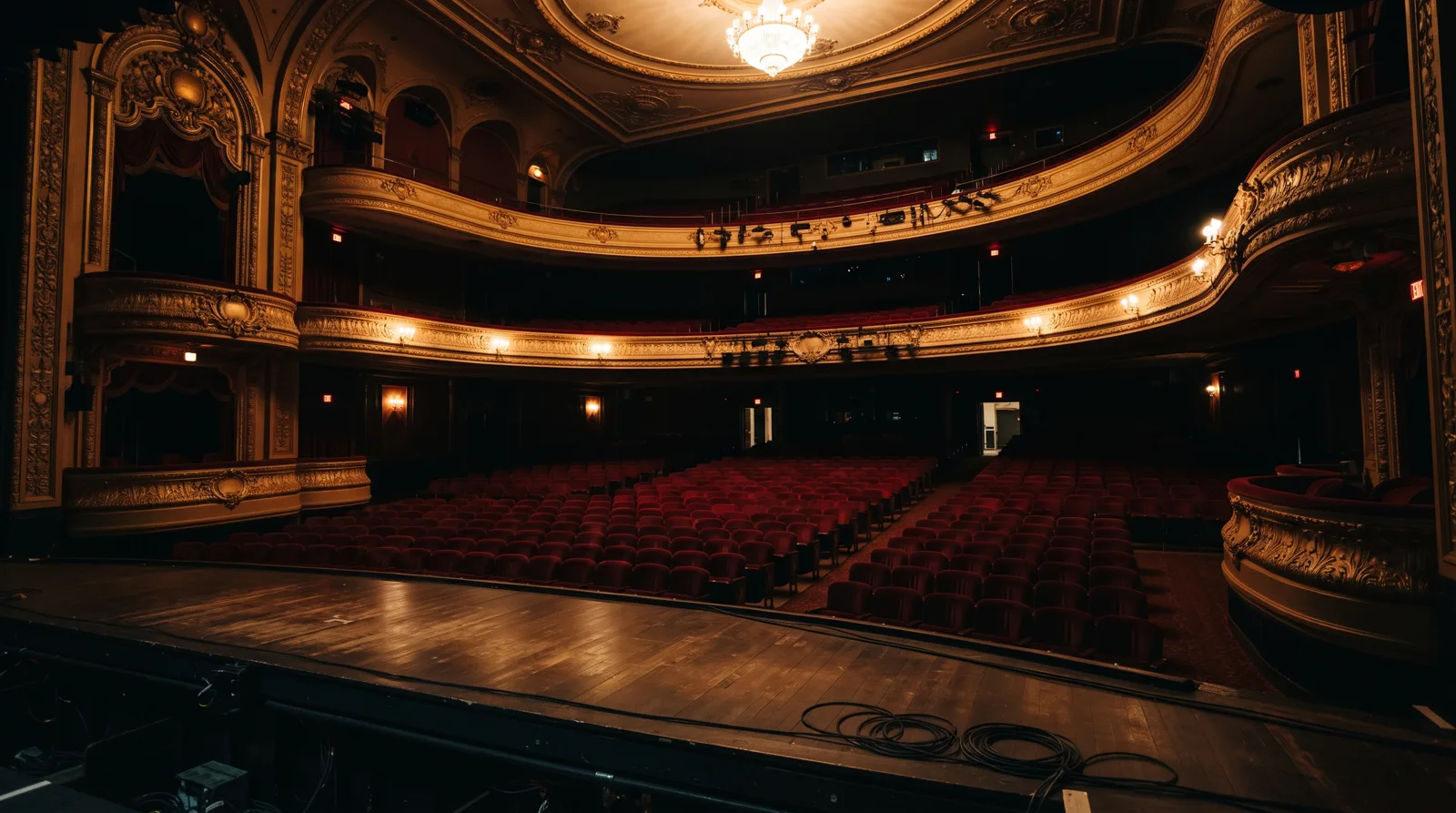

Okay, so. The industry has been running a particular experiment this season, and I have been watching it from my seat very carefully. The experiment goes like this: take one streaming platform with eight-figure production money, attach a face from their most-watched series, build a Broadway production around that face like scaffolding around a beam, and see whether the audience follows the beam out of their living rooms and into a theater. It has worked, in the sense that tickets have sold. It has not always worked in the sense that anybody onstage actually inhabited the material.
“Frequency” opened at the Thayer on Thursday night. I need to tell you what happened.
Camille Duvane has spent two seasons in the streaming drama “The Mireille Pact,” playing a French intelligence officer with the kind of specificity that a close-up rewards. That is a real skill. It is not the same skill as holding four thousand square feet of stage with your body while forty ensemble members rotate around you, the lighting rig swells above you in a wash of split amber and violet, and the orchestrations underneath you are building to a sustained note that the whole room is holding its breath for. Those are different muscles. Some performers who arrive from streaming don’t know that yet. Camille Duvane knew. That is the conversation I actually want to have.
Here’s the thing about choreographer Adaeze Nnachi’s work in “Frequency”: she is doing something with density that I have rarely seen deployed at this scale. The company starts every large production number with a stripped formation, maybe eight bodies, with the remaining ensemble visible but still at the upstage edge. She then builds each number outward in waves, four or six bodies joining each time a new harmonic layer enters the orchestration, so that by the climax you are watching thirty-eight dancers and the geometry of the stage has completely transformed. It is not accumulation for spectacle’s sake. It is a visual argument that frequency itself, the whole metaphor this show is built around, is something that starts small and expands until it fills every available space. I have not seen this particular structural choice executed this cleanly since Petra Voss did something adjacent with a company of twenty-two at the Midtown Dance Festival three years ago, and that was a much smaller room. THIS, in a Broadway house, is a different animal entirely.
Now, the honest note.
The book has a problem in the second act. Playwright Desmond Adeyemi is working with material that wants to be both a personal story and a statement about connection at scale, and in the forty minutes before the finale those two ambitions fight each other instead of feeding each other. There are three consecutive scenes where Duvane and co-star Ren Okafor are required to do the dramatic heavy lifting without spectacle underneath them, and the writing doesn’t give them enough to work with. You feel the effort. The show earns its way back by the time act three lands, but that middle passage costs you some of what the first act built.
What it earns back is this: Duvane in the second act finale doing the thing that the live stage is the only place on earth you can do. There is no close-up. There is a performer choosing to use her whole body as a transmitter, center stage, while the lighting rig above her goes from blackout to full white in two beats and the ensemble hits a formation shift so precise it drew a sound from the audience that was not applause. It was a single, collective exhale. THAT is what you cannot manufacture with a streaming budget and a recognizable face. You have to earn it in the room.
The industry is still figuring out what the stage actually asks for. Some productions are writing checks the performers can’t cash. “Frequency” is not that. It is a show that understands the full weight of the live promise and works all the way to the end of it.
Get yourself to the Thayer before this one sells out from under you.