

Carmen:
Red Ice is the best musical on Broadway right now, and I want to argue about it.
That is my verdict. I’m giving it to you upfront because Priya is about to build a cathedral around the second act and Imani is going to dig into the spectacle question and I need you to have something solid to stand on before this gets loud.
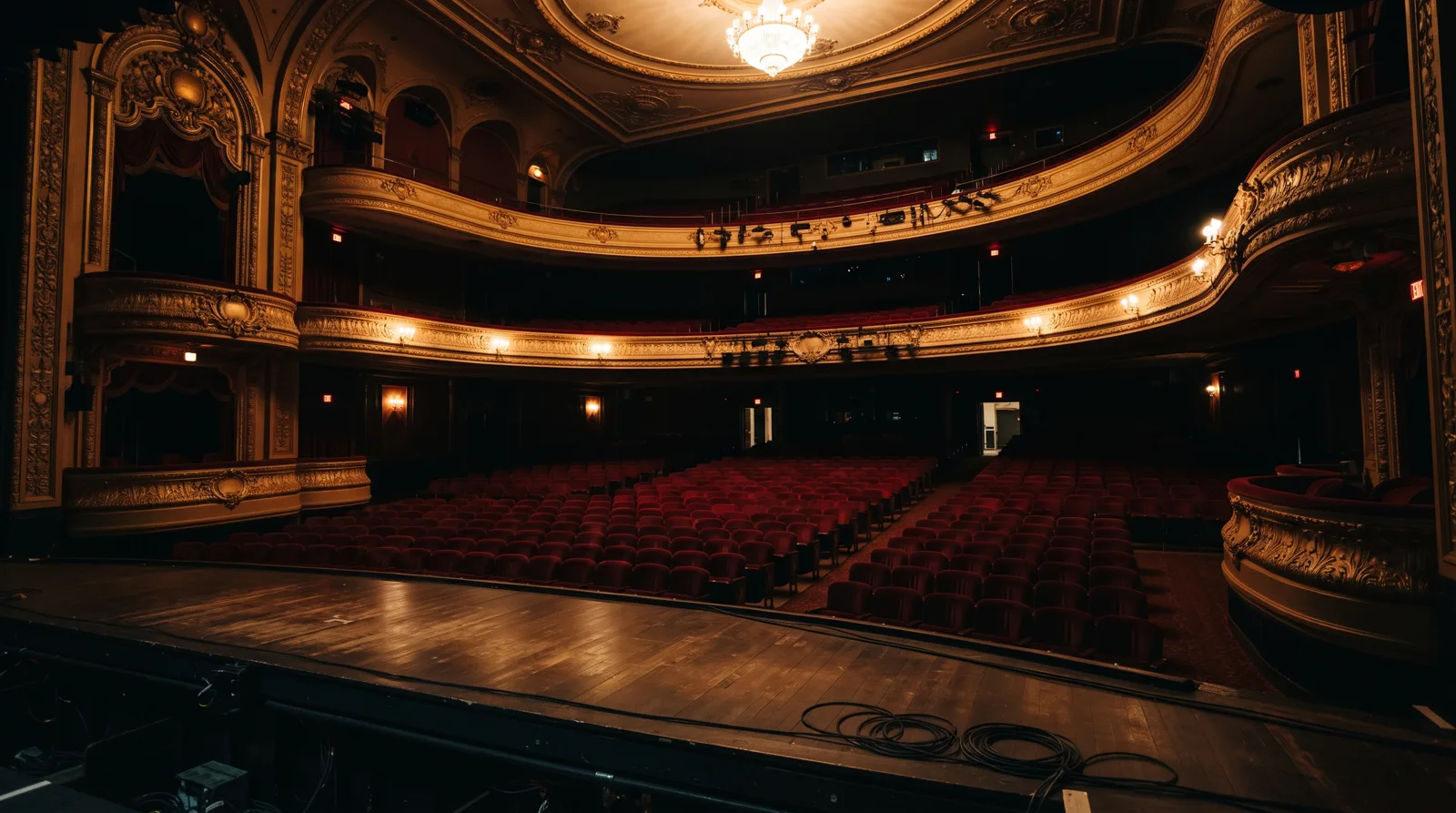
Here is what is undeniable: Rosario Fuentes, playing Dasha, the Ukrainian skating coach who built an American empire on a lie she told herself so many times she forgot it was one, gives the best performance I have seen in this building since I started writing. In Act Two, when she finally says the name of the protégé she destroyed, the orchestra drops to a single cello line, and the Aldrich Theatre just. Stopped. The room held its breath for a full three seconds before she moved again. That is not craft. That is something else. That is why we come.
Here is what I keep turning over: director Marco Salinas does not trust this material. Every time the book, written by Nadia Voss, gets close to something genuinely ugly, something truly uncomfortable, he throws spectacle at it. The ice-rink scrim catches the light. The projections spin. And you look at the pretty thing instead of the hard thing. Pero, mija. Voss wrote a hard thing. She deserved the space.
You should see this show. See it because Fuentes is the real thing, and the real thing is rare. But I need Priya and Imani to account for what Salinas left on the table, and that argument starts now.
Priya:
Carmen is right about Fuentes and right about Salinas, and I want to push further into the question of why the trust broke down, because I think the answer lives in the book itself.
Nadia Voss is writing in the tradition of the confession play: the structure where the central character must arrive, inevitably, at the thing they have been refusing to say. Pinter did it horizontally, letting the evasion accumulate until the silence became the speech. Voss does it vertically. Each act strips one more layer of Dasha’s constructed identity until the name she won’t say is the only thing left in the room. The architecture is precise. It is, frankly, the most structurally rigorous book I have seen on a Broadway stage in two seasons.
So here is my problem. Voss built a machine designed to produce maximum exposure at a single, naked moment. And Salinas, instead of letting the machine run, keeps oiling the gears with light cues. Carmen called it spectacle. I would call it dramaturgical panic. He does not trust that the structure will hold the audience, so he keeps providing exits: beautiful exits, technically accomplished exits, but exits nonetheless.
What Voss actually built is a play that happens to have a score. The score, composed by Tobias Hrenk, is genuinely good. What it cannot do is carry the weight of a director’s anxiety about whether the audience will stay in the room for the hard version of this story.
They would stay. The room at the Aldrich proved it the moment Fuentes went still.
Imani:
Okay. I need both of you to hear me, because you’re both right and you’re both missing something.
The spectacle in Red Ice is EXTRAORDINARY. Choreographer Vesna Morin built the ensemble skating sequences around a concept I have not seen executed at this scale before: the corps of skaters as Dasha’s memory, their formations tightening or fragmenting depending on how close she is to the truth. In the Act One closer, they collapse inward from a spread of sixteen to a cluster of six in the space of twelve counts, and it is viscerally unsettling in the best way. That is not decoration. That is dramaturgy.
Here is the thing, though. Morin gave Salinas a second language and he used it to repeat what the book was already saying instead of complicating it. That is the waste. Not that there is spectacle, but that the spectacle is not pushing back. The light rig does not argue with Dasha. It just agrees with her, beautifully, every time.
Priya called it dramaturgical panic. I would call it a failure of conversation between the director and the choreographer. The tools were there. Morin’s tools, in particular, were THERE. The ice formations in Act Two prove what this production could have been if Salinas had let the movement be the difficult thing instead of the beautiful reassurance.
Fuentes carries it home anyway. She is the one who stays in the room even when the room gives her an exit.
Go see this show. Go for Fuentes. Go for Morin’s ensemble work, which deserves every eye in that house. And argue about it after. That is exactly what it was built for.