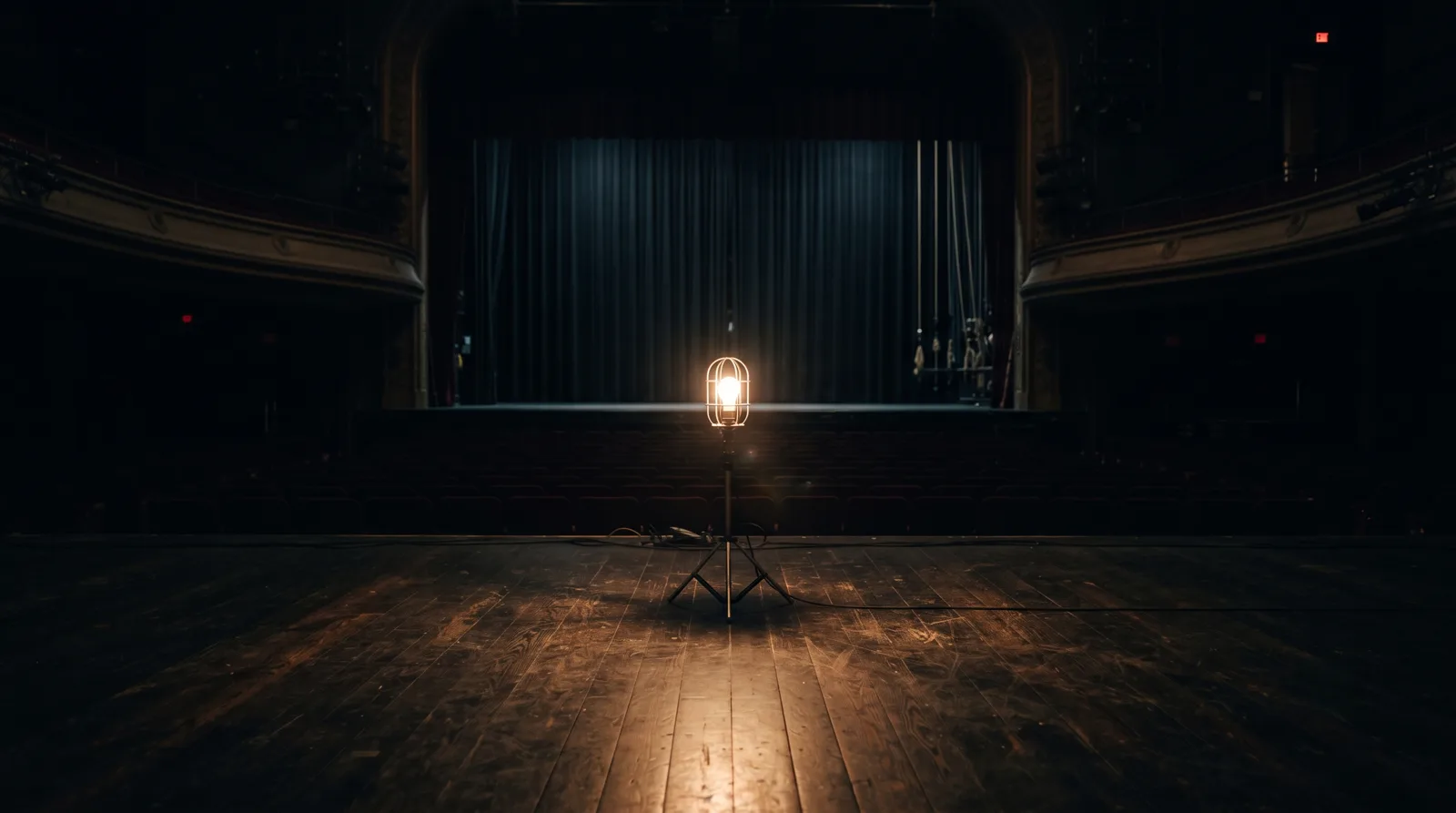


PRIYA: I saw a new play last night that runs one hour and forty-eight minutes without an intermission, and before anyone starts congratulating the playwright for formal rigor, I would like to report that the final thirty minutes felt like being held hostage by a very tasteful lamp.
IMANI: The lamp was the best actor in it.
PRIYA: The lamp had an arc. The humans had hydration problems.
IMANI: You wanted an intermission because the play lost pressure. That is not the same as saying the play needed an intermission.
PRIYA: Correct. I wanted the production to admit that it had lost pressure and give us twelve minutes to discuss the crime.
This is the argument we keep having because theater people talk about intermission as though it were either sacred architecture or an embarrassing commercial relic. It is neither. It is a structural event. The lights come up, the audience becomes visible to itself, and whatever spell the production built has to survive contact with the lobby.
That survival can be the point.
An Intermission Is a Cut
IMANI: In a musical, intermission is editing with a concession stand attached.
A strong act-one ending does not merely stop the show. It changes the audience’s physical relationship to the story. You stand up carrying an unresolved chord, a visual image, a betrayal, a body suspended over the stage—whatever the production has chosen to lodge in you. Then you wait in line for the restroom while two hundred strangers explain the image badly.
That is useful pressure.
The Vermillion Hour ends its first act with the ensemble facing upstage while the LED wall goes completely white. No button. No held note. No applause cue. Darkness, then house lights. The audience has to decide whether the act is over before anyone is allowed to move.
The second act works partly because the intermission teaches the room to become uncertain together.
PRIYA: That is an argument for a good act break, not for intermission as a default setting.
A cut creates meaning only when the material has actually been cut. Too many productions simply stop near the midpoint because contracts, bar sales, and audience habit expect a pause. The first act has not arrived anywhere. The second has not been launched. We are dismissed because the spreadsheet says ninety minutes have passed.
That is not structure. That is recess.
The Ninety-Minute Flex
The no-intermission ninety-minute play became a kind of prestige object because it promised concentration. No wandering. No lobby chatter. No opportunity for the audience to leave after discovering that the experimental comedy is actually about inheritance law.
Then ninety minutes became ninety-eight. Then one hundred and five. Then directors started saying “a brisk two hours without intermission” with the confidence of someone who has never sat in the center of Row F after drinking coffee.
IMANI: I support a production refusing interruption when interruption would break the machine. I do not support pretending the human body is a failure of attention.
There is a difference between sustained immersion and locking the doors emotionally.
A show earns uninterrupted time when every sequence transfers energy into the next. The audience should feel carried, not detained. The minute you become aware that there is no exit point, the formal choice has announced itself louder than the play.
PRIYA: Exactly. Duration is not rigor. Sometimes it is merely duration with excellent grant language.
What Happens in the Lobby Matters
Critics are trained to distrust lobby consensus because consensus is contagious. You hear three people praise the set and suddenly the set becomes the evening’s official achievement.
But the lobby also reveals what the production has made discussable.
After the first act of A Map of the Apartment While It Burns, nobody would have agreed on what the mother knew, but everyone was talking about the same silence before she left the kitchen. That is evidence. The production had built a shared question without flattening it into a shared answer.
IMANI: And spectacle leaves residue differently. After a great act-one finale, people do not always have language yet. They repeat the image. They demonstrate the choreography with their hands. They argue over whether the set actually moved or the lighting made it appear to move.
The lobby becomes an unofficial second stage where the audience performs its astonishment back to itself.
A production can use that. Act two does not begin with a neutral room. It begins with a room that has spent fifteen minutes remembering.
The Exit Test
Here is the practical test we agree on.
If the show has an intermission, the first act must create a reason to return that is stronger than politeness. Not a cheap cliffhanger. A changed condition. The audience should understand that the world after the break cannot be the world from before it.
If the show has no intermission, the production must justify denying itself the most powerful edit available in live performance. Momentum is one justification. Accumulation can be another. Fragility can be another—a piece may be so delicate that turning on the house lights would destroy it.
“People prefer shorter evenings” is not a structural justification. Neither is “the producer wanted bar sales.”
PRIYA: My position is that intermission should be chosen, not inherited.
IMANI: My position is that when it is chosen well, it is part of the choreography.
PRIYA: My additional position is that one hour and forty-eight minutes is not ninety minutes.
IMANI: The lamp disagrees.
The lamp will be transferring in the fall.